written by Lisa iesse, featuring interviews with Patti Sevensma and Kimberly Grace Gill, Tommi Merelin, Hugo Dagois, and Generoso Marco Realino
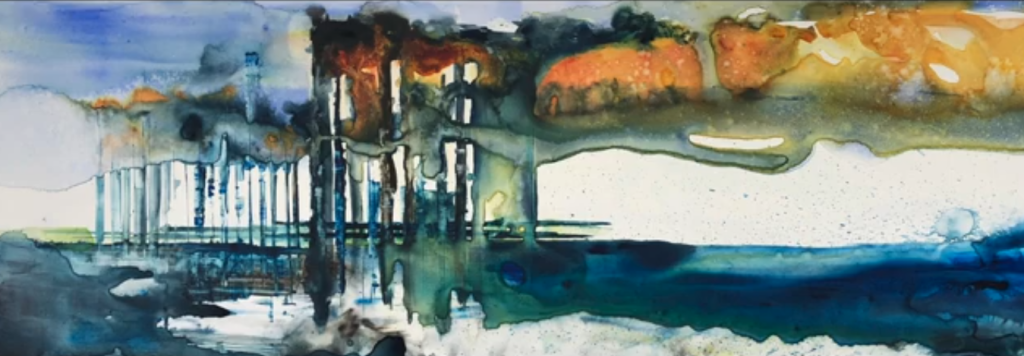
At work and at play, people seem to be spending more and more time online, immersed in “virtual” environments. The click of a mouse can spark a journey to discovering online art platforms and galleries for art veterans and newcomers, who slip into what might be called the art multiverse.
Virtual art galleries have been fueled by pre and post-pandemic trends, including the constraints of skyrocketing operating costs. But the increasing accessibility and rising popularity of virtual art spaces means it’s a “whole new ballgame” for artists, some insiders say.
Virtual art spaces are revolutionizing the ways art is exhibited and housed, making art not only more accessible to audiences but giving more power to the artist to control and benefit from their artwork.
From the Louvre to the hip grass roots galleries of New York and Mexico City, curators, artists, and audiences are using virtual galleries and exhibits to carve new spaces of “opportunity” and “possibility.”
August Current (AC) sat down for a (virtual) conversation with five trailblazers from four different organizations who are shaping this movement.
Digital Art Galleries Born from New York’s Traditional Brick-and-mortar Venues
Patti Sevensma, who is the president of the International Society of Experimental Artists (ISEA), explains that virtual art spaces started changing the art scene about 15 years ago, shortly after the economic crisis of the late 2000s.
At the time, Sevensma was working in the art scene at galleries and she witnessed many galleries go under.
“The other thing was Covid and lockdowns, more galleries closed because they could not afford to be there.”
Sevensma says that there just aren’t as many physical galleries as there used to be.
“To make money, to keep on painting, you’re going to have to figure out a virtual way to sell it, get it out there.”
Sevensma believes it’s a trend that’s here to stay and it’s also much more cost effective for artists to exhibit virtually, than having to pay commissions for traditional brick-and-mortar venues to exhibit their work.
Before 2011, ISEA had one exhibit per year and it was in person only, explains Sevensma. Over time it became evident that expanding into online exhibits would open the door for more artists and their work.
ISEA has over 500 members all over the world.
Their annual INNOVATIONS exhibit is open to the public to enter. This exhibit takes place in person and virtually in a different city each year.
For ISEA, community engagement has only increased with their online exhibitions.
For Sevensma and Kimberly Grace Gill, working alongside a team of about 40 volunteers, organizing ISEA’s art exhibitions is a full time labor of love, that involves continuous communication and coordination between a community of artists and art lovers.
ISEA’s website is linked to an image site called SmugMug which holds high quality images and artists’ statements from all of their art exhibitions going back to 2011.
The collections are open to all art affectionados exploring the digital art world from home.
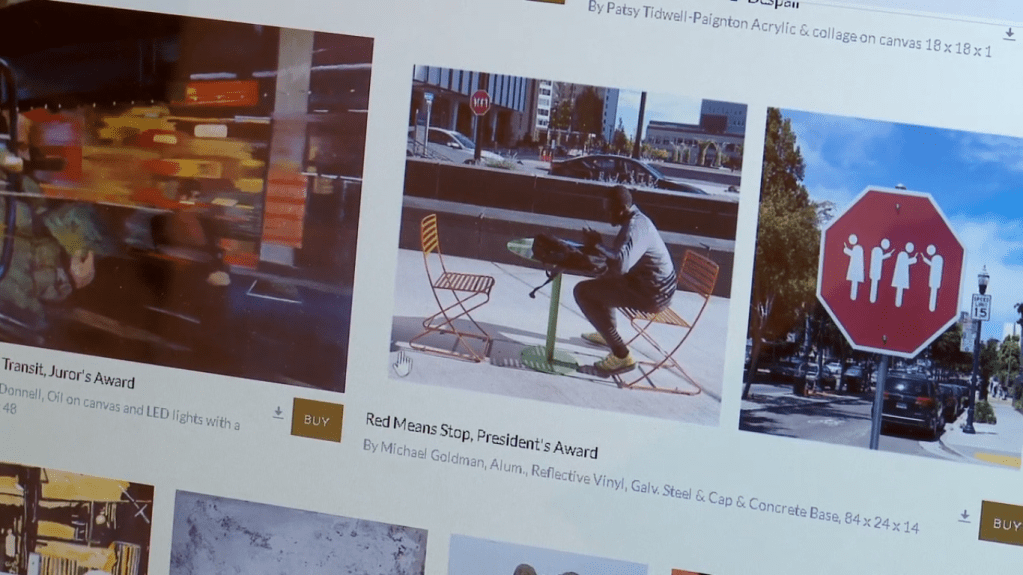
One exhibit alone this year saw 200 different original works of art, whose images were uploaded into ISEA’s virtual image gallery.
Each year ISEA hosts three art exhibitions and two are completely virtual, featuring everything from paintings and sculptures to photographs, digital works and film, along with 2D and 3D mixed media images and much more.
“We have our first piece this year that has been accepted (for INNOVATIONS) that was actually presented as AI being part of it,” Sevensma told AC.
INNOVATIONS 2024, will take place at the Central Park Place in Grand Haven Michigan September 7 through October 31th, 2024, with images of the works posted to the site on September 18.
ISEA uses a platform called Cafe to post callouts to artists inviting them to enter their work.
Calls are closed for INNOVATIONS but their annual exhibit Utterly Profound is accepting art submissions. This exhibit will take place from October 15 to 31, with the images posted to their site on November 15.
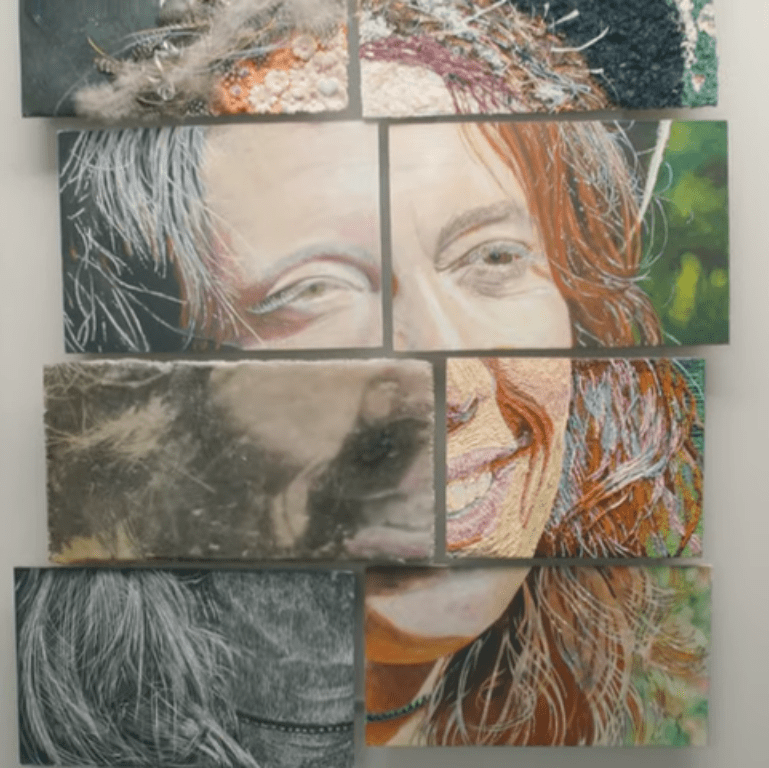
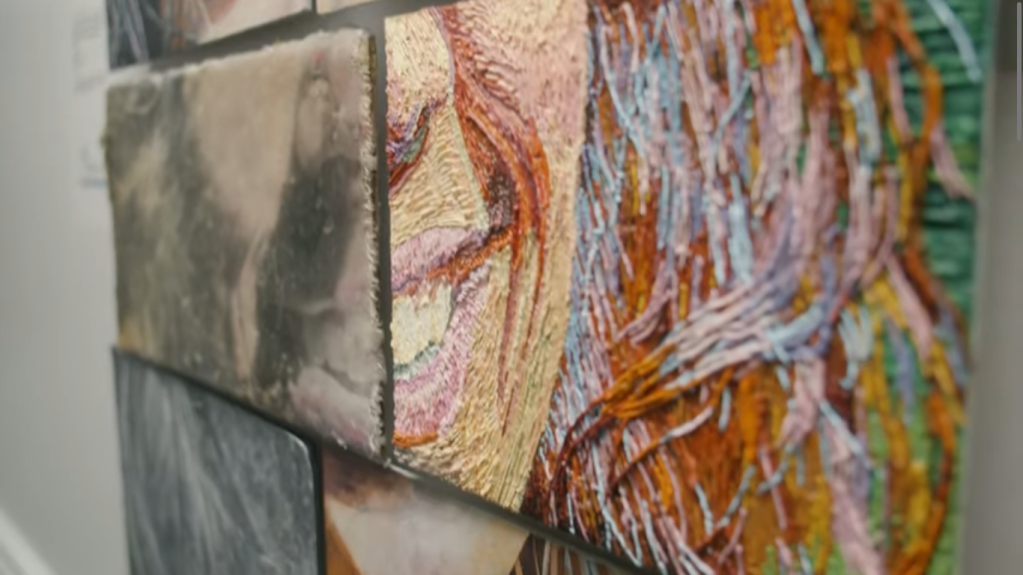
ISEA gives out about 20 awards, worth a total of $14,000 US in prize funds each year.
For ISEAs two virtual shows, it’s very important the artist provides quality photos of their work or a copy of their original digital file, that would qualify digital pieces as original art, explains Sevensma.
Installations require a video.
“They would have to walk around the room showing all the parts and of that insulation in order to make it a piece of art that could be viewed by anybody anytime anywhere. I guess I think more in terms of that when I think of virtual,” says Sevensma.
“Virtual can be film very easily and it can be a YouTube channel. You can see all kinds of virtual art on YouTube.”
“Motion is a big part of showing things virtually and it really does help people get more and more involved in and feel like they’re part of what’s going on.”
Creating online art spaces, whether it’s digital exhibitions or videoed virtual art tours is part of that movement, because they have the power to engage artists.
It pushes artists to “go that extra mile,” to enter into shows and feel good about who they are as artists and their work,” explains Gill.
Online Art Curation Democratizing the Art World
AC also spoke with Tommi Merelin, who is the chief officer of a company called the Virtual Art Gallery.
The Virtual Art Gallery’s main office is located in Helsinki, but the virtual galleries on their platform feature art created by over 15,000 artists from over 100 countries around the world, explains Merelin.
“Democratizing the whole art world, that is our goal,” says Merelin.
Part of that change means giving artists more control over not only how their art is presented, but where it is housed.
“They also can keep the if it’s a physical painting that they have or sculpture, or they can keep it in their space, they don’t have to hand it over to a gallery.”
Virtual galleries offer many advantages and benefits compared to traditional exhibition spaces.
“The handling of art is quite expensive because you have to pack the (art), you have to transport it, you have to hang it on the walls. If you have expensive paintings, you really have to be careful.
Merelin says artists frequently lose about 50 percent of their sales in the process.
But Merelin explains their virtual galleries are not trying to replace the “real experience” of seeing art in person.
Instead it’s the “next thing” to a traditional visit, a way to get “more eyes” to see an artist’s work.
Merelin says the platform has advantages to other online environments, because it involves the artists in online art curation.
“For example, with online art stores and Instagram, you are only ever seeing one painting at a time. So you are not creating this kind of curated exhibition, you are creating social media posts if it’s one image”
In comparison, the virtual gallery platform makes the experience “more immersive” showing “the real scale” of the pieces, how they relate to the space, and the “real feeling” of the exhibit as a whole, says Merelin.
“Because it’s interactive, it’s multimedia. There’s a lot of possibilities that your physical museums don’t offer.”
Many of the virtual exhibitions featured on the platform combine audio and visual elements to create immersive environments.
Navigating virtual art exhibitions effectively means embracing those possibilities for a more immersive interaction with online art.
Most people spend about five minutes viewing exhibitions in the virtual gallery. That may not seem like much time, says Merelin, but considering the fraction of time people might spend looking at an Instagram post, it’s substantial.
“People are actually spending time with your art, they are examining it. They are really feeling it. Compared to one image on a website.”
The most popular virtual galleries on the site have attracted thousands of visitors in the first hours, and tens of thousands of visitors in total, says Merelin.
Compared to a regular art exhibition, which is based on one physical location, virtual exhibits have the potential to create more traffic, explains Merelin.
The platform is made to make art more accessible.
“We actually created text to speech explanations for every artwork,” available in multiple languages, says Merelin.
Their virtual gallery technology is designed so that users can navigate the galleries with just their keyboard or touchscreen.
This is a way for people to experience art in a safe space without having to physically get to a gallery.
Many great artists who have created beautiful, extensive exhibitions on the site are members of the Phoenix Autism Foundation.
Creating a gallery on the site is also free, and doesn’t require a credit card, explains Merelin.
Merelin says the platform refuses to act as “gatekeepers” by choosing what art should be exhibited
“We are giving the freedom to sell, anything, freedom to exhibit anything and the freedom for the customers to choose what is good art and which is not.”
Giving artists and audiences that freedom makes fertile ground for some of the best virtual galleries for art exploration, says Merelin.
These alternative, independent art galleries share an online presence with major galleries like the Guggenheim and the Louvre, who offer virtual museum tours, online art exhibitions and digital art galleries .
https://www.guggenheim.org/artwork
https://www.louvre.fr/en/online-tours
Virtual Tours Open the Doors of the Louvre for Free
AC also spoke with Hugo Dagois, who is the deputy director of HD Media, the company behind the Louvre’s virtual tours.
Making the museum more accessible to people who may not otherwise have the opportunity to see the Louvre’s artworks and artifacts was one of the goals, explains Dagois.
Creating the virtual tours has given people with mobility challenges and people living in distant parts of the world a chance to see the exhibits featured in the Louvre.
In Paris, it is common for middle school students to visit the Louvre as a class. And now it is possible for middle school classes from faraway places like Thailand to visit and have that experience, says Dagois.
“With the virtual tours they can visit the Louvre wherever they are,” Dagois points out.
He adds that the tour is free, and most of the Louve’s main exhibits and “blockbuster-type” shows can be found on the virtual tour.
Dagois explains that whether an art exhibit is included in the virtual tour is decided by the people involved in the art’s commission.
The Louvre has become “more accessible, and more accessible online,” says Dagois.
Just during a three month period in 2020 during the pandemic 4 million people took a virtual tour of the Louvre.
The virtual tours have also helped to reduce the crowds at the Louvre.
Prior to the pandemic the Louvre saw about 45,000 visitors per day. In 2022, as crowds began returning when lockdown measures were removed, the Louvre began enforcing a daily limit of 30,000 visitors per day.
Dagois explains that HD Media is also using virtual technologies to create a “virtual twin” of museums like the Louvre, to record and document artworks, architectural spaces and artifacts in case of fire or other natural disasters.
“Most of them are really enthusiastic about the technology,” but Dagois adds that what he has also heard from audiences is that the virtual tour will “never replace the real visit inside.”
Dagois explains the virtual tours allow for people to experience the atmosphere of the museum virtually, but current technology is not able to convey the multisensory experience of being physically present in a space.
Where is the current technology going next, Dagois says he doesn’t know but Artificial Intelligence (AI) will certainly play some part in the future.
At the moment virtual tours are en vogue, and for many galleries and museums virtual gallery tours are a marketing tool. “You want people to come so you tease them with the virtual tour,” explains Dagois.
Virtual Art Shows Immersing Audiences in the Life and Work of Artists
AC also spoke with Generoso Marco Realino, who is the president and CEO of Visioni Srl, based in Rome, Italy.
Visioni’s immersive exhibits are designed to create virtual art shows where the spectator experiences “a total immersion” in images and sound.
Visioni is a producer and distributor of hugely popular “esperienze immersive” (immersive experiences) which have featured the works of legendary artists like Frida Kahlo, Vincent Van Gogh, and most recently Maqbool Fida Husain.
The Rooted Nomad is an immersive experience that draws from nearly 160 extraordinary works by Husain from the Kiran Nadar Museum of Art (KNMA) Collection.
M. F. Husain is among the most celebrated artists of the 20th century. He was one of the founding members of Bombay Progressive Artists’ Group. Husain was connected to Indian modernism in the 1940s and the Bombay Progressive Artists’ Group. His narrative paintings, made in a modified Cubist style, used bold, vibrant colors. From Gandhi to Mother Teresa, the Ramayana, the Mahabharata, and the British Raj, his works prolifically conveyed the diverse people and subjects shaping rural and urban life across India’s rich history.
M.F. Husain’s 1967 film “Through the Eyes of a Painter” experiments with sounds, music, shifting from landscapes to abstract images to create an immersive experience. Husain worked with diverse mediums including painting, photography, film, print, texts and poems.
KNMA says the goal of the immersive show is to “ignite a deeper appreciation and curiosity” about MF Husain’s life and his art.
“By constructing a profound sensory experience, the exhibit encourages visitors to explore and learn more about the artist’s indelible legacy.”
The complex production includes motion graphics, live action, 2D and 3D animation, choreography and sound design.
Realino says by engaging with the work of Husain, it is possible to become part of the re/genesis of his art.
As written on the Visioni site, “The viewer’s vision becomes the set of emotions that, by living “inside” the work, adds meaning to the work itself. This interaction between the artwork and the spectator is the core of our Art.”
Realino says for him what’s most important is “il grande deposito” (the great repository) where art is housed, a place full of wonder and curiosity. Both the artist and the audience play a critical role in that process of navigating art spaces.
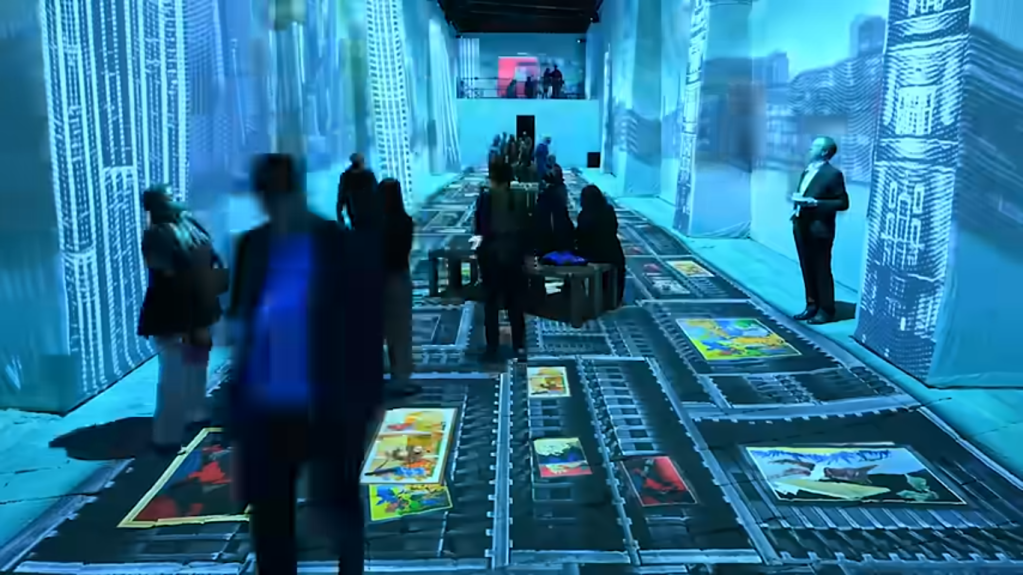
The immersive experience comes from this continuous path.
The Rooted Nomad is in part immersive and in part an in-person exhibition.
Realino explains this was a choice that was made together with KNMA.
KNMA and Visioni decided to combine these two “strumenti” (tools) – that of the immersive show platform and that of KNMA.
Working together in close collaboration with the KNMA was key for the project, because there was a great respect that the immersive production of Husain’s work, The Rooted Nomad, was deeply connected to the exhibit of the same name at KNMA. Realino explains the project was born out of a collaborative desire to bring the great art and cultural works of Husain to the world. Realino says he was truly honored when KNMA contacted Visioni to collaborate to create an immersive show of Husain’s works.
But Realino emphasizes that immersive shows are not meant to be a tool used to substitute for the work of Husain. It’s all about how the technology is used, he explains.
People who come to the immersive shows, come to see an immersive show of an artist’s work which is not a substitute for the artist’s work itself.
Realino says these spaces can coexist.
Immersive shows carry “Una sua anima” – a soul of their own, that respects the life and great work of Husain, explains Realino.
Realino compares the use of immersive and other technologies to a kitchen knife, and warns if it’s used in the wrong way it can become a weapon.
Realino adds AI has great potential, but must be coordinated by people, especially in artistic fields.
Tips for Engaging with Virtual Museum Tours, Gallery Tours and Exhibitions
Platforms like Google Arts & Culture provide a gateway for finding virtual museums and gallery tours across the world.
The platform boasts over 2,000 international art exhibits, so it’s a good place to start “gallery–hopping” and exploring the art world online.
A message from the platform invites spectators to “step inside” the London Royal Academy of Arts, to visit Japan’s Nakamura Keith Haring Collection, and browse the National Museums of Kenya,
Audiences can engage with the work of particular artists, like Frida Kahlo, and even tour the places she lived, like the Casa Azul in Mexico City.
https://artsandculture.google.com/project/frida-kahlo
https://www.museofridakahlo.org.mx/virtual/?lang=en
Kahlo’s diary, which she painted and wrote in from her bed, opens the door to vast new dimensions and new worlds.
Museo Dolores Olmedo offers a virtual peak into Khalo’s diary https://artsandculture.google.com/story/9AWxmDksayhmJA
On platforms like Google Arts & Culture, finding contemporary artists and art that challenges the boundaries of art and emerging technology like AI is still quite rare.
The work of critically acclaimed veteran New York artist Stephanie Dinkins has combined art and narrative with AI.
https://www.stephaniedinkins.com/conversations-with-bina48.html
Dinkins describes the project Conversations with Bina48 as “a quest for friendship” with a humanoid robot. The project looks at how social, cultural and future histories are “codified at the intersection of technology, race, gender and social equity,” she says. Dinkins explains the quest became “a rabbit-hole” of questions about the future,
What are the best exhibits and galleries for virtual art exploration and how can audiences find them?
With so many virtual galleries to choose from, it’s a question that creates virtually limitless possibilities for a growing global community of artists and art lovers to decide.
 AugustCurrent
Leave a comment