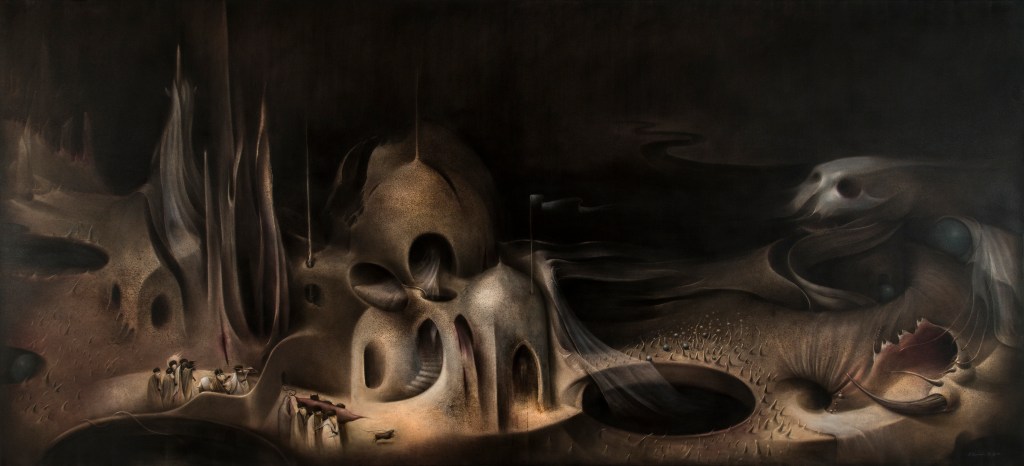
Artist Vahid Chamani told AugustCurrent that the creation process of art begins with personal experiences and is cultivated by interactions with diverse cultures. “Inner truth will transcend all boundaries and geographical limitations,” says Chamani, reflecting on the healing power of art creation.
Born in Tehran in 1984, Vahid Chamani grew up amid the culturally rich landscape and enduring, complex history of Iran.
It was through the creation process of his art that Chamani embarked on a journey of self-awareness and a deeper sense of his identity in connection to the world around him.
“I always try to find a piece of myself in my imagination. Through this, I gain a better understanding of myself and my surroundings. This self-awareness allows me to identify and express my concerns through my art. As I go through this process, I become more aware and deeply concerned about societal and environmental issues. I aim to raise awareness and knowledge within society about these issues,” Chamani tells AC
Chamani graduated from the Tehran Academy of Fine Arts in 2000. Soon after receiving his Bachelor’s degree in art from Soureh University in Tehran in 2007, Chamani’s work began getting noticed in art circles internationally. However, Chamani never thought his artistic journey would lead him to where he is today.
“Initially, I envisioned myself as an art instructor, painting only in the solitude I had created to express my personal feelings and heal my wounds. The solitude and silence were incredibly valuable to me,” Chamani tells AC.
Chamani’s work has featured in galleries worldwide, from Tehran to Paris to London to Kuala Lumpur, where it has attracted international acclaim.
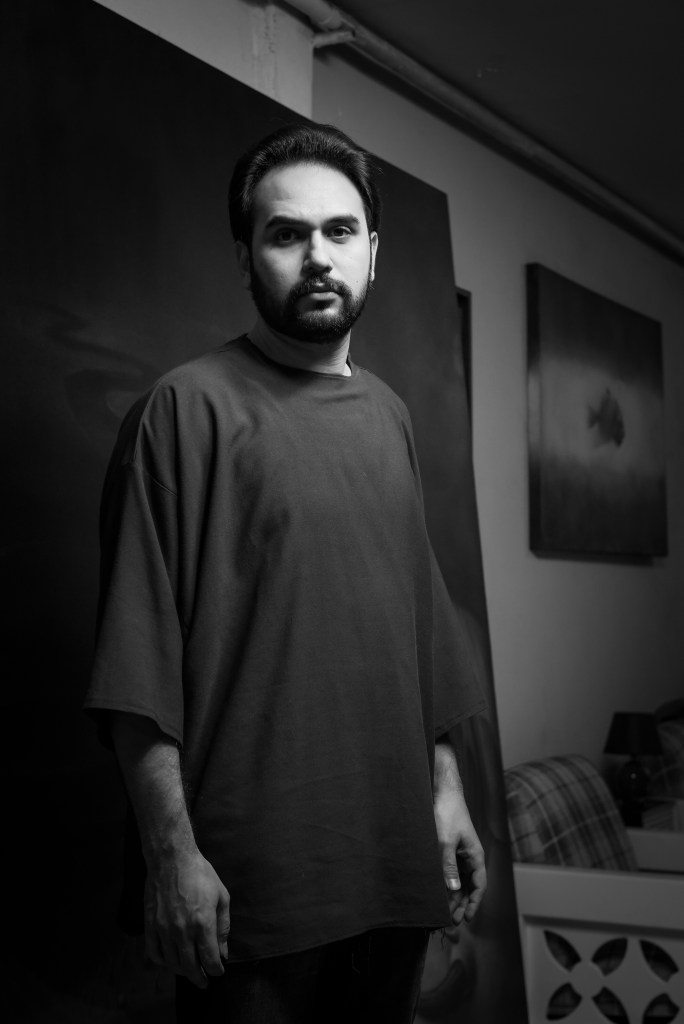
“It never crossed my mind that the art stemming from the deepest part of my being would be exhibited far from my homeland, where people are unfamiliar with my region’s culture, history, and current situation, yet it would still resonate with them,” he says.
In turn, Chamani has been influenced by people across the world who have connected to his art.
“As years passed, my perspective expanded, and I encountered individuals who connected with my art not only locally but globally, which broadened my outlook even further,” he reflects.
During his childhood, Chamani often sought peaceful spaces of solitude, opting out of sports or games with his childhood peers.
“I found solace and comfort in painting, which allowed me to escape into my imagination and stories. This solitary pursuit was one of my most cherished activities,” Chamani reflects.
Chamani has chosen the title Amino Acids for all of his works.
“Amino Acid is the fundamental element of the human body cell and all other creatures we are all made from a common core but with different forms. I chose this title because I have followed the same concept, my works have a common core but have different forms and presentations,” he explains in his artist’s statement.
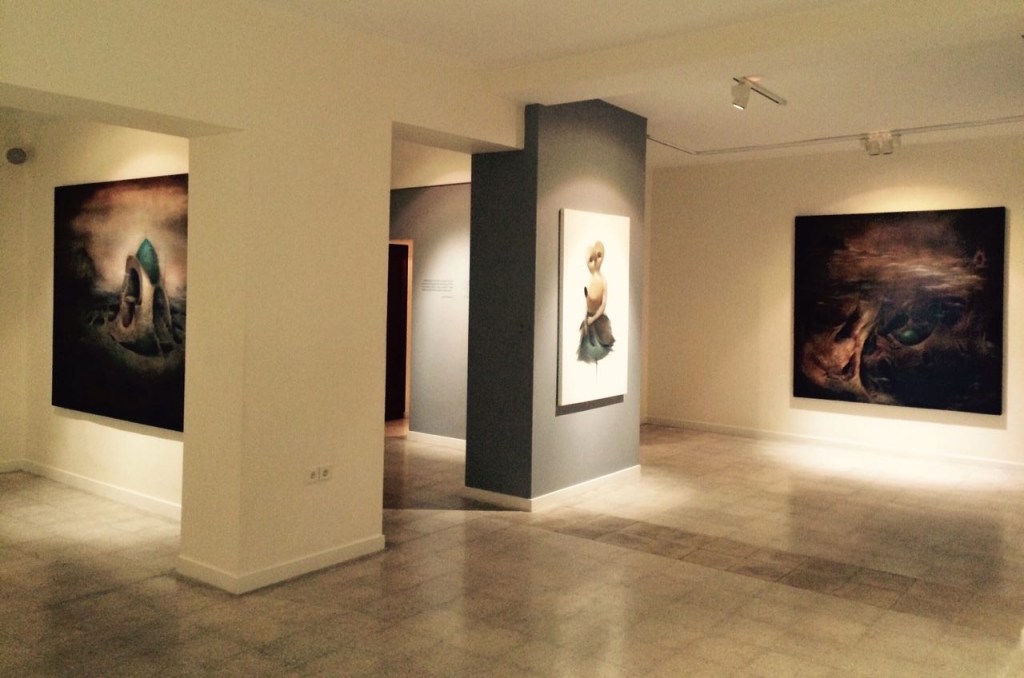
In Chamani’s 2021 short film of the same name (https://youtu.be/agpo_uBT2Ps), the artist spoke about the ways his art continues to explore ongoing mysteries.
“Visually speaking, the topics I’ve chosen for my works have similar content but covering different issues. I’ve worked on a variety of collections but the connecting line among them, which I call my current concern, is something that is not answered in my mind, which is why I keep repeating it.”
“What is obvious in my works is that the Ghajar period has visually influenced my works a lot,” explains Chamani.
The Ghajar period took place between 1797 to 1925 was previously regarded by some historians as a time of social decay. The period is now being recognised by many historians as a time of major political and social transformation.
It was a period of renaissance for Iranian literature and arts. Towards the end of this period, in the early nineteenth century, Iran held its independence amid an era of Western imperialism. Around this time, Iran converted its traditional tribal society into a modern Iranian nation-state.
Chamani explains that in his view, Iran’s art held a common essence and ground until the end of the Ghajar period.
“This is why I am deeply attached to this era. It is also because I hold that the sequence of the history of painting goes back to the Ghajar period,” he says.
“What I mean is that if one tends to follow the art of our painting from a very long time ago to now, there is a missed chain after the Ghajar period onwards,” he adds.
For this reason, Chamani intertwines the techniques and styles of more contemporary periods with the Ghajar period. He does this to better understand contemporaneity since the Ghajar period.
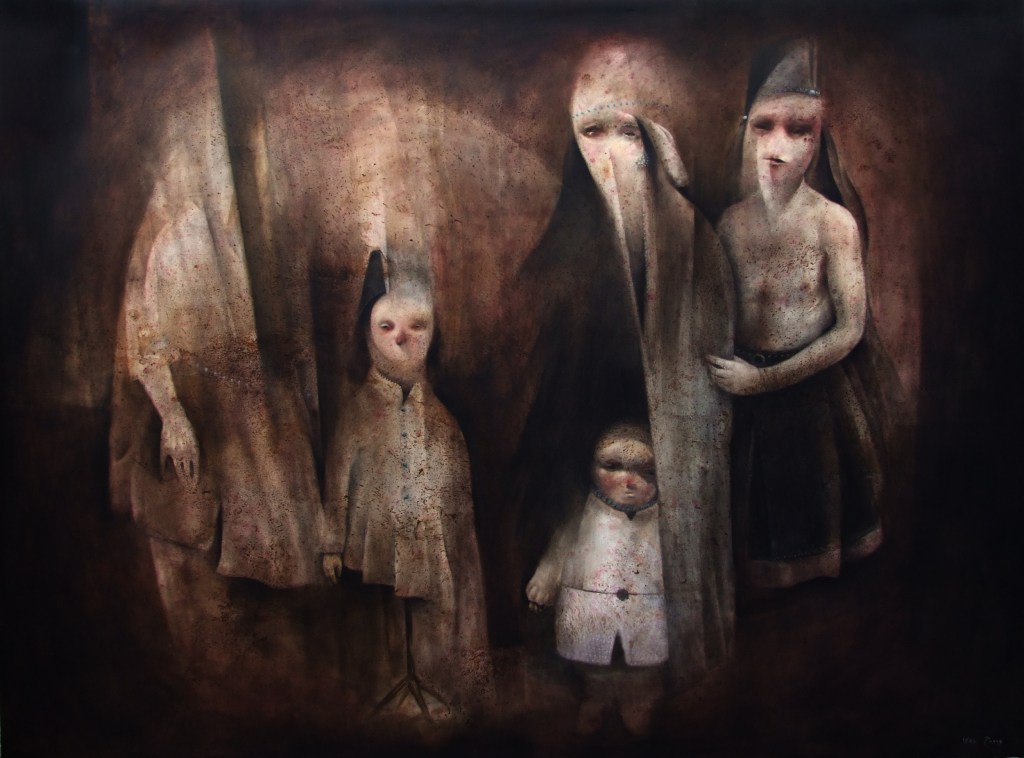
In his artists’ statement, Chamani has said his work mainly deals with Iran’s present cultural condition which is disrupted by “deep contrasts between tradition and modernism.”
Chamani uses ink, a medium of traditional Iranian painting, and oil paint, considered a more “modern” medium. In his portraits, the figures often wear traditional clothing belonging to Ghajar and Sassani dynasties or clothing from different periods of Iranian history.
“These are used in modern spaces with modern lighting and western glazing mixed with Iranian traditional signs and icons.” In Chamani’s works, these elements exist beside each other.
His paintings convey the disturbing “contrasts” that manifest in the gap between cultural tradition and “modernism.”
“We have somehow turned away from our traditional culture but at the same time been left behind by modernism. We have distanced ourselves from our beliefs and now stand far from them to be able to join in the global stream of modern cultures but it seems like we have failed in reaching both of them,” Chamani says in his artist’s statement.
Chamani speculates that this hesitancy to go with the flow of that global stream has created a sense of limbo.
“Maybe this is because we are doubtful of this liberation and don’t want to separate from our past. This has put us in some kind of cultural gap where we can’t find our true place in Western modernism.
Chamani shows this gap in his works, where dark and even coloured backgrounds “show a theme of having no place and time,” and where people feel “doubtful of their identity” and concerned for their future.

“The contrast between tradition and modernity is a significant topic in Iran today. Our society holds traditional beliefs, but we also embrace and appreciate modernity and the Western perspective,” Chamani tells AC.
‘The duality of our identity poses a great challenge for the upcoming generation, just as it did for my generation,” he adds.
Chamani’s work addresses the complexity of Iranian history and identity.
“In my artwork, I try to represent this crisis by referencing different eras of Iran’s history, especially in the last centuries, and merging historical concepts with contemporary approaches. Nowadays, the identity crisis is a crucial challenge for people in Iranian society, and I aim to capture this historical sadness in my work by addressing the “identity crisis.”
The social landscape of Iran is a significant focus of Chamani’s intellectual, and artistic inquiry.
““‘It’s undeniable that the current issues and regional dynamics have influenced my work,” he tells AC.
In the film, Chamani explains that as an artist, he draws from the special abilities and knowledges that are rooted in his existence as a human being. He uses all of these deep knowledges each time he works.
At the same time, Chamani’s work tackles the ways that people face tremendous barriers in their ability to shape their social and political landscape.
“We cannot affect our environment and social situations as much as they affect on our manner and personality. What I mean is that human control over the instruments and media is much less than their control over us which makes it extremely hazardous,” he says.
There is a “stress and anxiety” that echoes in the portraits which convey that sense of precarity.
“What I call stress and anxiety in the portraits often (presents) as an anxious face, and we can see anxiety in the way (the figures) look is rooted right from my serious anxiety towards the future which is transmitted in these portraits as well.”
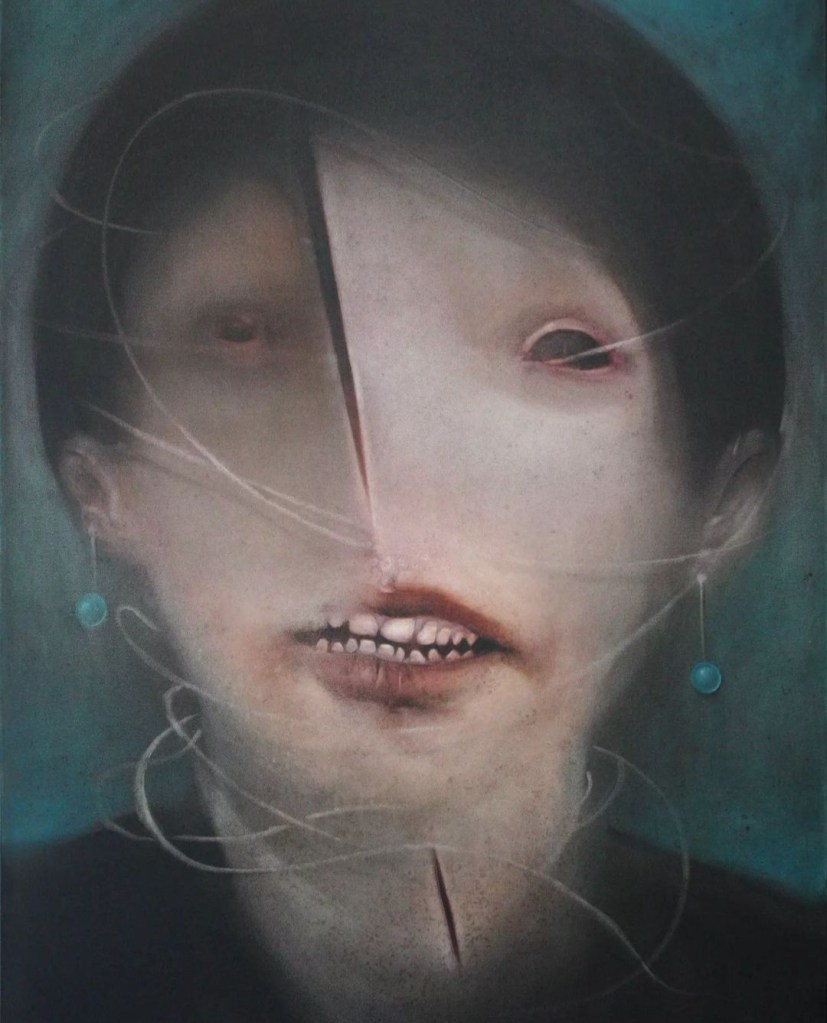
Chamani focuses on light, colour, and content to convey contrasting emotions and ideas simultaneously at work in his paintings.
“Through my paintings, I aim to express both despair and hope for life using colours and elements. For instance, the eyes often appear empty but not blind, and the characters convey a sense of depression and worry without being entirely hopeless. Despite their struggles, these individuals dress up and apply makeup daily, showing a determination to preserve their beauty and their lives,” he asserts.
Chamani’s work often tackles those forms of cultural violence that linger beneath the surface.
“In some (works) I have used ornaments like earrings and necklaces with shiny faces on pretty figures who although have put on a lot of makeup still have their traditional dresses on, a sign of their inner want for returning to past cultures and in spite of that, trying to keep up with new trends of fashion, in order to hide their fear of being called backward,” explains Chamani in his artist’s statement.
Some of the figures and faces in his work are shown “with two different sides” to convey their inner distress. “Some eyes are blind and some show disappointment with traces of scars they have on their hearts and souls, few have hopes.”
Although he has not positioned himself as a political artist, the rising tensions and crisis in the Middle East have left a significant mark on Chamani’s life and work. Yet he refuses to let that define his art. Chamani’s work is about so much more.
Chamani’s journey as an artist is about engaging with the possibilities and energy of life and art together with the audience, within the complex history and social realities of Iran.
“I am committed to my art and take responsibility for it. First and foremost, I focus on enjoying the process of creating art. Then, I aim to support my audience in developing their knowledge and awareness through their feedback,” he tells AC.
For Chamani, creating his art is a process that is inextricably interwoven within Iran’s rich historical and cultural tapestry.
“Reviewing and analyzing history, culture, and social issues is an important part of this responsibility, in my view.”
But it’s always with a focus on personal experiences that Chamani channels a deeper perspective of the cultural and social conditions shaping life in Iran.
“I strive to delve deeper into political and social matters, avoiding a superficial understanding shaped solely by media portrayals. My approach involves analyzing these issues based on my knowledge and perspectives and drawing ideas from my personal analysis. The enduring sensitivities, complexities, and historical challenges in the Middle East compel me, as an artist, to engage with these issues rather than remain indifferent. While I haven’t positioned myself as a political artist, the geographical context drives me to tackle the surrounding issues more profoundly and experimentally in my art.”
Chamani paints improvisationally, without a plan or pre-drawing, which he says has posed unique technical and stylistic challenges he has learned to overcome through practice and experience. However, Chamani has faced many challenges that go far beyond technique and style.
He has found that the main challenge lies in the content of his artwork. Chamani’s works show covert forms of cultural oppression, making what might be hard to see or invisible, making those experiences more overt and visible. Making the implicit explicit has brought severe scrutiny to his work at times.
“I have had to remove my artwork from exhibitions on multiple occasions. The censorship I experienced was the biggest challenge; however, despite these limitations, I have never self-censored in my studio for the creation of experimentation, and I always create whatever I believe or feel about.
Chamani explains that galleries sometimes have run into difficulty displaying some of his works. Despite that barrier, he has remained true to his artistic vision, and proud that those situations have not caused him to “self-censor”
He encourages emerging artists to draw inspiration beginning from their personal experiences and interactions with the world around them.
Chamani says that although it’s important to experience different cultures and connect with the world, each person’s unique and authentic beliefs and ideas are what the world truly needs.
“I believe that everything you need to create art is within yourself. You don’t need to search for inspiration and creativity elsewhere.”
 AugustCurrent
Leave a comment